Every business owns valuable assets, from brand names and logos to website content, software, and innovative products. Protecting these assets helps businesses build recognition, prevent unauthorised use, and maintain a competitive advantage.
However, many business owners do not understand the difference between trademark, copyright, and patent protection. Choosing the right option depends on what you want to protect and how you use that asset.
Understanding trademark vs copyright vs patent helps entrepreneurs, startups, and established businesses make informed decisions about intellectual property protection in India.
What Is the Difference Between Trademark, Copyright and Patent?
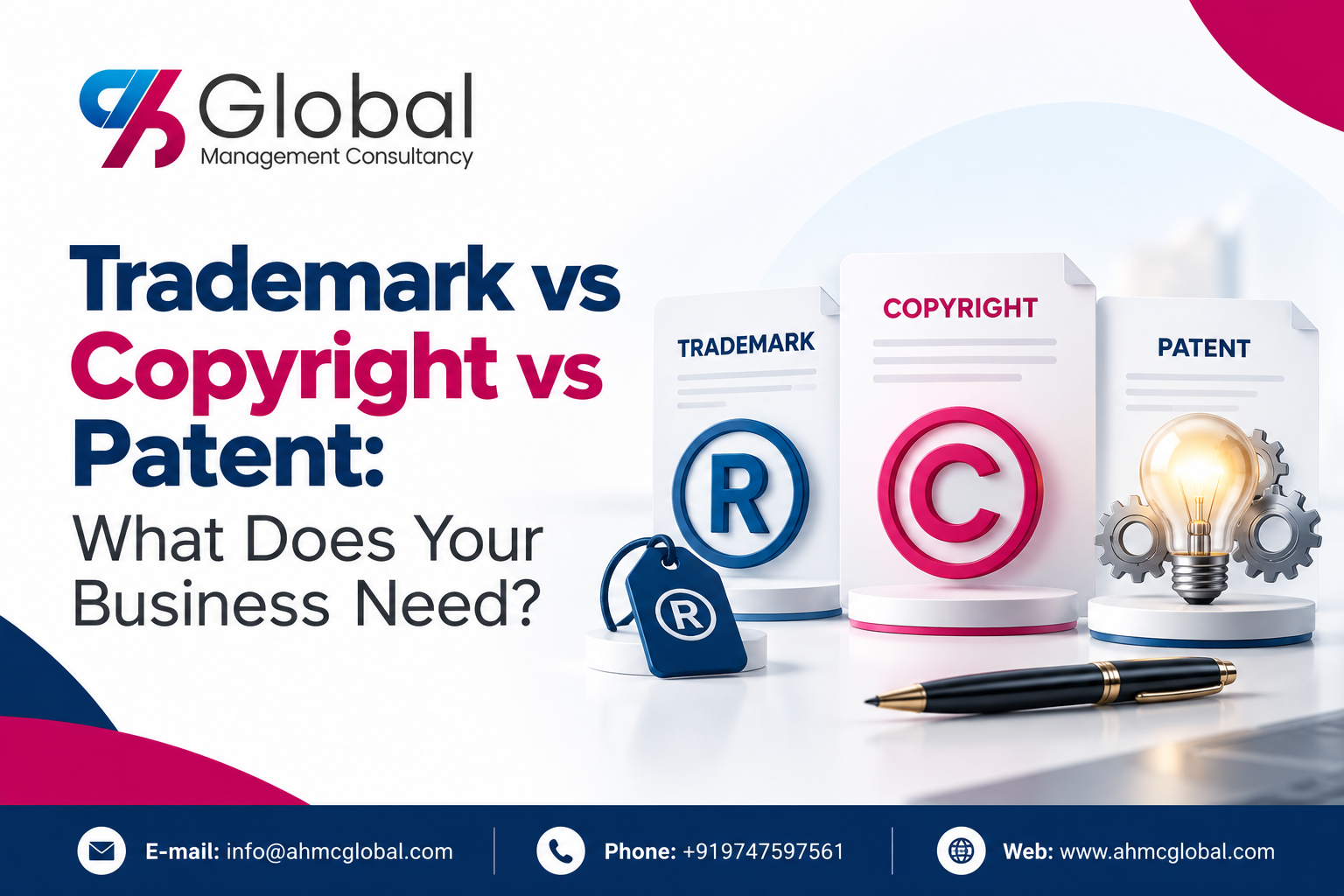
A trademark protects brand identifiers that distinguish a business’s goods or services. Copyright protects original creative expression, while a patent protects qualifying inventions that meet legal requirements.
| Feature | Trademark | Copyright | Patent |
|---|---|---|---|
| Protection | Brand names, logos and distinctive signs | Original creative works | Qualifying inventions |
| Purpose | Protect brand identity | Protect creative expression | Protect technical innovation |
| Indian law | Trade Marks Act, 1999 | Copyright Act, 1957 | Patents Act, 1970 |
| Registration | Recommended for stronger statutory protection | Generally not mandatory | Required to obtain patent rights |
| Duration | 10 years per term, renewable | Depends on the work and applicable law | Generally 20 years from filing, subject to legal requirements |
These rights protect different assets. A business may need multiple forms of intellectual property protection for its brand, creative materials, and inventions.
1. What Is Trademark Registration?
A trademark is a distinctive sign that identifies the source of goods or services. It helps customers recognise a business and distinguish it from competitors.
In India, trademarks are governed by the Trade Marks Act, 1999.
What can a trademark protect?
Trademark protection may apply to eligible brand assets such as:
- Business and product names.
- Distinctive logos and symbols.
- Brand slogans and taglines.
- Other distinctive signs used for goods or services.
For example, a clothing business using a distinctive brand name may apply for trademark registration to protect its identity against conflicting commercial use.
Trademark registration can strengthen legal protection, support brand recognition, and help businesses take action against infringement. Registered trademarks may also be licensed or assigned, subject to applicable law.
Before applying, businesses should conduct a trademark search, select the appropriate goods or services, and identify the relevant trademark class.
In India, a registered trademark generally remains valid for 10 years and can be renewed for additional 10-year periods.
2. What Is Copyright Protection?
Copyright protects original creative expression. In India, it is governed by the Copyright Act, 1957.
Copyright may apply to original literary, artistic, musical, and dramatic works, as well as eligible software, films, and sound recordings.
What can copyright protect?
Examples include:
- Website articles and blog posts.
- Original photographs and illustrations.
- Promotional videos and graphic designs.
- Books, reports, and training materials.
- Eligible computer software and code.
For example, a digital marketing agency that creates original blog content, videos, and promotional graphics may own copyright in those works, depending on the circumstances and applicable agreements.
Copyright generally does not protect an idea, business method, or company name by itself. It protects the original expression of an idea rather than the underlying idea.
Is copyright registration mandatory in India?
No. Copyright generally arises automatically when an eligible original work is created and fixed in a suitable form. Registration is not mandatory, although it may provide useful evidence in ownership disputes.
Businesses should maintain creation records, contracts, and written agreements with employees, freelancers, designers, and agencies to clarify ownership and usage rights.
3. What Is Patent Protection?
A patent protects a qualifying invention, such as a new product or process that provides a technical solution to a problem.
In India, patents are governed by the Patents Act, 1970.
What can a patent protect?
Potential examples include:
- A new mechanical mechanism.
- A qualifying manufacturing process.
- An innovative technical device.
- A product incorporating a patentable technical solution.
For example, an engineering company that develops a new water filtration mechanism may explore patent protection if the invention meets the legal requirements.
An invention generally must satisfy novelty, inventive step, and industrial applicability. Certain categories of subject matter are excluded from patent protection under Indian law.
Patents can help businesses protect technical innovation, negotiate licensing agreements, and develop competitive advantages. However, public disclosure before filing can create problems for patentability, so professional advice is recommended before revealing an invention.
A patent generally lasts for 20 years from its filing date, subject to statutory requirements and applicable renewal fees.
Trademark vs Copyright vs Patent: Which Does Your Business Need?
The right protection depends on the asset you want to protect.
Choose trademark protection if you want to protect a distinctive business name, product name, or brand logo used to identify your goods or services.
Consider copyright protection for original website content, photographs, videos, illustrations, training materials, and eligible software.
Explore patent protection if your business has developed a potentially patentable technical invention that meets the applicable legal requirements.
For example, an appliance manufacturer may use trademark protection for its brand name, copyright for original product photographs and manuals, and patent protection for a qualifying technical mechanism. Its product appearance may also qualify for separate industrial design protection.
This demonstrates why a business may need several types of intellectual property protection rather than relying on a single registration.
Common Intellectual Property Mistakes Businesses Should Avoid
One common mistake is assuming that registering a company name automatically protects the brand as a trademark. Company registration and trademark registration are separate processes.
Another mistake is believing copyright protects an idea or prevents competitors from creating similar products. Copyright protects original creative expression, not ideas or technical functions as such.
Businesses should also understand that filing a patent application does not guarantee approval. The invention must meet the relevant legal requirements.
Finally, intellectual property rights are territorial. Registration in India does not automatically provide equivalent protection in every other country.
Final Word
Understanding trademark vs copyright vs patent helps businesses protect their brand identity, creative work, and technical innovations.
Trademark registration is relevant to brand protection, copyright safeguards original creative expression, and patents may protect qualifying inventions. Choosing the appropriate protection early can help reduce risks and support long-term business growth.
AHMC Global provides business consultancy and compliance support to help businesses understand their requirements and identify suitable next steps. Visit AHMC Global to learn more about its services.
Frequently Asked Questions
Q1: Can a logo be protected by both trademark and copyright?
Q2: Can I patent my business idea in India?
Q3: How long does intellectual property protection last in India?
Q4: Is trademark registration necessary for a small business?
This article is for general information and is not professional advice. Rules, limits and due dates change, so please confirm the current position for your situation.